Wednesday, May 20, 2015

High Morale or Big Victories?

The topic we recently covered in class was the second half of the Revolutionary War, which was Saratoga through Yorktown.  In class, we discussed the question, Did the Americans win the war because they had high morale or because of a few big military victories?  To answer this question, we watched videos, answered questions and took notes.  We studied a few topics, including battles in Trenton, Princeton, Saratoga, Valley Forge and topics like brutality in the South and Yorktown.  The Revolutionary War was made up of many battles, and some of the battles the Americans won and some they did not.  The battles are about not just who wins them, but each side’s morale level as well.  Some battles gave the Americans high morale and some were just big military victories.  I believe that the Americans won the war because of their big military victories.
Maintaining high morale is important for any team or army in anything, especially battles in a war.  At Valley Forge, the American soldiers faced many difficulties.  One difficulty was the cold and lack of food,  and people were freezing or starving to death at a rate of 10 per day.  Also, they only had enough food for 8 days to last the whole winter.  Not only the soldiers, but the horses were also starving to death and so they were running out of horses for transportation.  Another difficulty was that there were no hospitals and when a Typhus epidemic came, many soldiers died.  Lastly, many officers went home for the winter.  But through all these difficulties, the soldiers struggled together and grew closer together and were training together while the British in Philadelphia were partying and not training.  This event helped maintain high morale.  Philadelphia also helped maintain their high morale in the beginning because it is a legendary place for the Americans.  Philadelphia is where the Declaration of Independence was written.  But the Americans did end up losing Philadelphia and that really made their morale take a dip.  The event in Saratoga was put into the category of maintaining high morale and winning big military victories.  Saratoga was a turning point in the war because the Americans defeated a large portion of the British army, and it led to French alliance and the British surrendering.  British morale took a beating during the event in Charleston.  Over 5,000 Americans became prisoners and were put on prison ships that were hot, contaminated with germs, crowded and lacking food.  While some events really helped moral, more hurt it and for that reason, winning big military victories was the reason why the Americans won the war.
The Americans had big military victories and that is why they won the war.  One big battle was the Battle at Saratoga.  Although Saratoga was a turning event for high morale, it also helped raise the amount of big military victories.  At Saratoga, the Americans defeated the British army and the British surrendered.  Also, this led to French alliance for the Americans.  The French provided the Americans with a lot that helped them win further battles, like in Yorktown.  They provided them with a secret loan, as well as arms, ammunition, uniforms and troops and naval support.  They also gave reinforcements that protected Washington’s forces in Virginia.  The battle at Saratoga was the basis of all the following battles the Americans won that helped lead to the end of the Revolutionary War.  American soldiers were also successful at Trenton and Princeton.  Working hard to defeat the British really paid off and helped contribute to America’s big military victories.  But, the most important battle and military victory was at Yorktown.  The American’s won at Yorktown because of their alliance with the French.  The French helped them win this battle by acting as distractions and reinforcements for their army.  One battle that brought the American army down was the Battle at Charleston.  Charleston also hurt their moral.  In Charleston, there was a siege and the British surrounded them with cannons.  This is when 5,000 Americans became prisoners.  Their big military victories is why the Americans won the war.
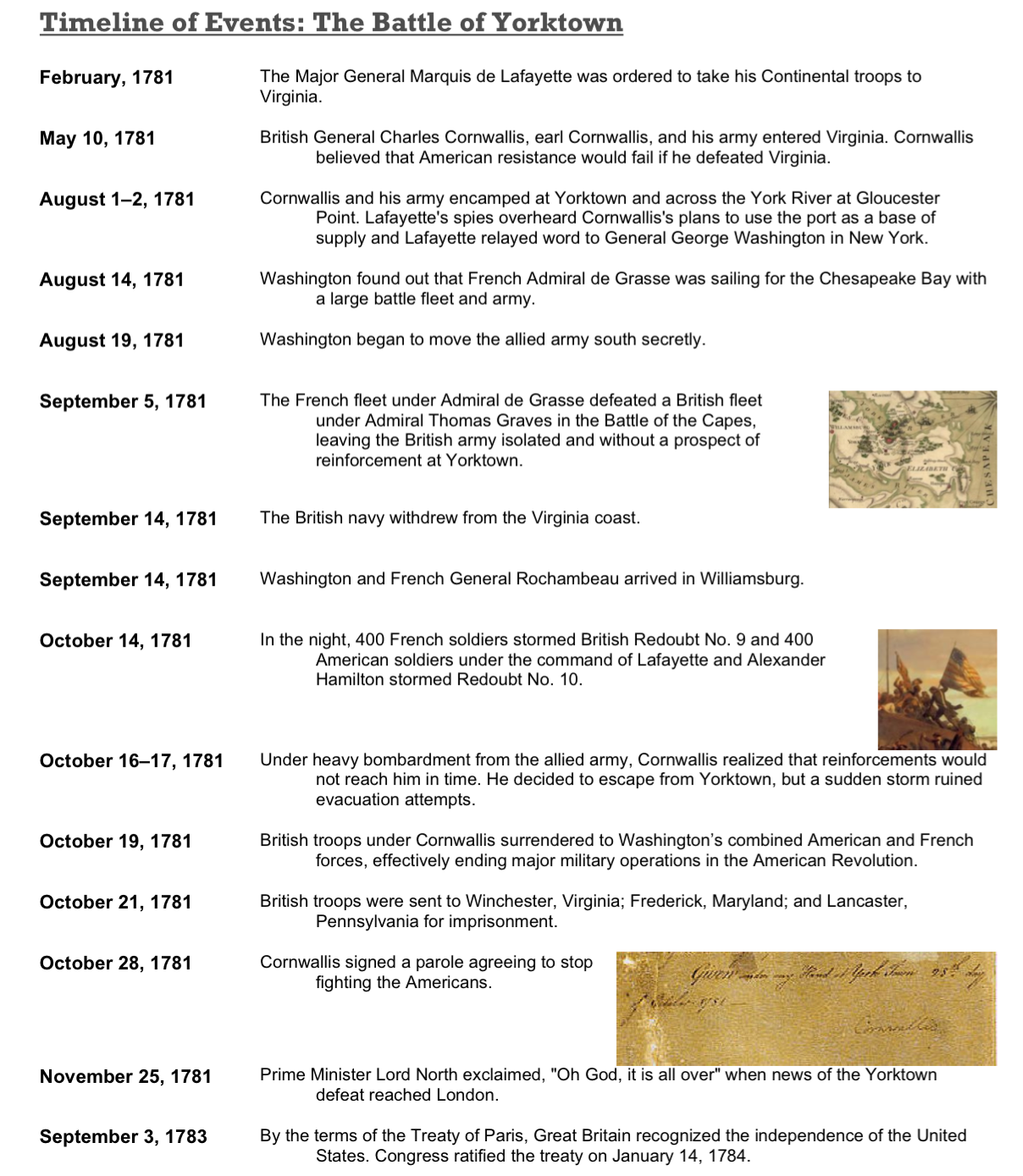

Maintaining high morale is important in wars, but it all comes down to the battles the army fights in and wins.  Their level of morale went up and down between Valley Forge, Saratoga, Trenton, Princeton, Charleston and Philadelphia.  The Americans won the war because they defeated the British so many times in different places.  The biggest victory was in Yorktown and that was because they had an alliance with the French, which was made at the Battle at Saratoga.  Although Charleston was unsuccessful, that did not mess with their other wins at Saratoga, Yorktown, Trenton and Princeton.  The biggest impact on the American army was when the French allied with them to defeat the British, and without them, the Americans would not be able to defeat the British.  The Americans won the war because of their big military victories.

Monday, May 11, 2015

Washington's Leadership

 A good leader is trustful, strict but fair, and is smart.  

Washington was a good leader when he had success at the Battle of Trenton.  He had many stragegies to win the battle between them and the British.   One strategy was that he had Thomas Paine's pamphlet read aloud to to motivate and inspire his men.  He also did a lot of his moving around during the night so they wouldn't be found and had decoy fires set up to act like they were in for the night, but wer really setting up for a victory.  Washington also brought in reinforcements when he needed more people to help win the battle.  

Washington was a bad leader when he had punishment for mutiny.  One man, Macaroni Jack, was about to be lashed for a minor offense.  Before he was about to be whipped, he shouted out to the other men, brothers won't you help me.  Washington took this as a act to rebel, and had him killed.  This is not a good way to solve problems, especially during something as serious as war.  Good leaders are suppose to be able to solve problems in easy, not violent ways.  Washington was not being smart, becuase now the rest of his men don't trust him and he was being anything but fair. 

For the first half of the war, I believe that Washington was a good leader.  Although he made mistakes in his leadership, everybody isn't perfect and Washington had a lot on his hands.  He knew what had to be dome to win the war most of the time and he was a smart leader for the rest of the army. 

Thursday, April 30, 2015

The Worst Break Up


            The Declaration of Independence is a break up letter from America to King George. American colonists are declaring themselves separate from England.  This is a break up letter because America is "breaking up" with England.  This document was written before the American Revolution and it stated that America wanted to be its own country.  American colonists were not happy with the unfair way Britain ruled them.  King George was upset that he now had one less country under his rule.  He was probably also mad because he thought he was supporting America but was really not. He believed that even though he was making certain decisions, that doesn't mean he wasn't thinking about America and he thought they were too busy complaining about taxes.  After America broke up with King George, he decided to use his relationships with other countries to make America's future difficult and he sent soldiers over.  The break up between King George and America did not end of good terms.
            A preamble is an introduction that states the purpose of a document.  In the preamble, it states that the American colonists have the right to have a good relationship with King George.  They state that their rights are life, liberty and the pursuit of happiness.  Life, liberty and the pursuit of happiness are the Natural Rights.  Natural Rights are rights people are born with and they cannot be taken away from them.  In the preamble, they also say that it is the Right of the People to alter and abolish any form of government that is destructive to their rights and to make a new government.  This preamble relates enlightenment philosophy to the American colonists situation by the line consent of the governed.  America is telling King George and England that they want to be separate because they are not following the enlightenment ideas of government and are unfairly ruling America.
             A grievance is a cause for complaint or protest, especially unfair treatment.  The Americans included grievances in their Declaration of Independence to show the unfair ruling of King George and how they are protesting against Britain and the grievances are the examples they're using to become their own government and country.  One grievance is, "He has erected a multitude of New Offices, and sent hither swarms of Offices to harass our people, and eat out their substance.  For Quartering large bodies of armed troops among us." This is saying that one reason why America should form their own government is because King George sent out British offices to take more control over American colonists.  He sent armed troops over and took away their rights.  Another grievance is 'For cutting off our trade with all parts of the world.  For imposing taxes on us without our consent."  This is saying how American colonists broke up with King George becuse he cut off their trade with the world so they can't expand their economy.  Also, because he taxed them on a lot of unnecessary things that was working against the colonists and towards King George.  King George and the American Colonists did not have a good relationship and King George made it even harder for the colonists to start their own country and government, and that is why America broke up with King George.


Sunday, April 5, 2015

What Helped Started The American Revolution

  In class, we talked about the American Revolution and what lead to it.  One question we answered was, "how did the Enlightenment help fuel the American Revolution?"  Colonists wanted to have their own government and not be run by the british anymore.  One person who agreed with the enlightenment ideas was Thomas Paine.  Paine was a writer and he published writings based on the American Revolution and his thoughts on government.  In Biography of Thomas Paine Part 1 it says, "but once actual fighting had begun, he became convinced that only complete independence would work.", and "Once independence had been achieved, America could establish a central democratic republican form of government."  This shows that Paine agreed with the topic of consent of the governed. Later in the biography, it says, "Paine advocated a declaration of independence to secure European aid and to unite the colonies." which proves that he agreed to the concept of social contract. People in America believed that America had to break its ties with England and once independence was achieved, America could establish a central democratic republican form of government.  Paine had some influence on these enlightenment ideas that helped lead to the American Revolution.
     Another question my class answered was, "Were most American colonists ready for rebellion?"  When Paine's writings came out and people started to listen to him.  His supporters then became ready for rebellion and were willing to fight.  Some colonists did not agree with Paine and were loyal to the British.  They were not comfortable with Paine's ideas and thought he was against their beliefs of government.  People who should have loved him, hated him.  He was not known as a here because of his views attacking Christianity and organized religion, and he became politicly toxic.
     In class, we had to take excerpts from Thomas Paine's Common Sense publishing, and turn them into black out poems.  My partner and I were assigned excerpt ten.  We first read the excerpt, trying to understand the main idea, and then connect in to enlightenment.  After, we circled words throughout the excerpt to make a poem and blacked out the rest of the writing we didn't use.  The final poem is all the words that aren't blacked out and it flows throughout the excerpt.  The poems had to show that Paine agreed with enlightenment and talk about government in America.  Thomas Paine agreed with the ideas of enlightenment and it helped fuel the American Revolution.  Many colonists were on Paine's side and were ready for rebellion while others were not.

Thursday, March 12, 2015

Views on Social Contracts


   A social contract is contract between the people of a community that has a certain list of rules each individual most follow.  There are consequence to breaking these rules and in agreement to following rules, each person has guarenteed protection.  John Locke and Thomas Hobbes agreed with eachother and believed that social contracts were necessary because it was something that made each person contract with each other person and it was between the people.  Also because it wwas an enforceable agreement that made people follow rules or there will be consequenses.  They both thought it was necessary for the people to limit some of their rights for the return of their guarenteed protection.  Although they agreed on social contract, they disagreed on their opinions of human nature.  Locke's veiw on human nature was that all people want to protect their lives happiness, health and possessions and everyone will help to protect others' property.  Locke's views are well more positive than Hobbes.  Hobbes believed that people were basically selfish, and would do anything to get what they wanted, which included jurting and killing eachother.  He had a strong opinion based around the idea that people would always act in their self interest, no matter how bad it hurt others.  Some people believe that humans are all good while others believe that they are all bad.
     It is harder than it seems to create a social contract that people will agree on and follow.  Everyone has different opinions on how people should live an might never agree.  But when social contracts are made and people want their protection of their property, they have to be wlling to give up their rights and agree to all the rules.  In class, we split into groups to make a social contract with five rules that our class would have to follow if we all formed a group after the zombie apocalypse killed off most of thw world.  Since we only got to write fie rules, we had to make sure they covered hunting, government, food, shelter, jobs, defending yourself and hurting others.  One rule was that three leaders will be elected every three years.  Another was that you can't be destructive to yourself or others and can only use defense if you are going to be harmed.  Our third rule was that everyone has to have a specific job and contribute or they will be kicked out of the group.  Another rule was that all recourses found have to be shared and everyone in the group can use them.  The fifth rule was that all conflicts are to be brought to court.  My group and I all agreed that these rules, for the most part, cover the majority of rules people need to follow to have a civil society.
     After the groups made their social contracts, everyone went around the room and stuck sticky notes around the posters asking questions about their rules.  They could be critisism or compliments, or a general question about the rule and what happens if they break it.  One question we were asked was "why are they (leaders) elected every three yeats?".  But, my group meant to imply that three leaders were choosen every one year, so that is one thing we would have changed. Someone else asked,  "who is the judge in court?", so my group would make it more specific and say that the people will vote on electing leaders and judges of court, along with other important leaderships.  One last question someone asked was, "what if it's a simple conflict?", so my group would clarifty that all conflicts will be brought to court if it is disturbing many people in the group.  If it's a conflict that can be solved outside of the group, that will be better for everyone else.  Even though my group agreed that our rules were good, there will always be people who will find loopholes and won't agree and that is why it is hard to make a social contract everyone will be willing to follow.

Friday, February 27, 2015

"The Peasant Emperor"

The essential question we studied in class was “were enlightened absolute monarchs more enlightened or more absolute?” We did two activities in class to answer this question.  One activity we did was read about three enlightened absolute monarchs and made a venn-diagram.  The three monarchs are Frederick the Great, Catherine the Great, and Joseph II.  The venn-diagram we created distinguished the enlightened and absolute things the rulers did.  When we were done and discussed, it turned out that Frederick was the most absolutist, along with Catherine and Joseph II was the most enlightened. The next activity we did was split into small groups to make a propaganda poster.  Each group chose one of the monarchs and made a poster.  The point of these posters were show the enlightened things the ruler did, so the posters were biased towards them being enlightened rulers.  These activities helped us answer the question, were enlightened absolute monarchs more enlightened or absolute.

An enlightened monarch was one was benevolent.  They have a well informed and rational outlook when they rule and look at different perspectives, appealing to everyone’s needs.  Frederick the Great, Catherine the Great and Joseph II all considered themselves enlightened.  But they were also absolute rulers, so they are enlightened absolute monarchs.  An absolute monarch is one who has total and complete power of the citizens of the country.  By the mid 1600’s, citizens were fed up with the lavish lifestyles and costly wars of absolute monarchs.  So, many philosophers and scholars decided that reforms needed to happen.  They believed that these reforms would be best if they came from enlightened, benevolent monarchs.  But, these enlightened monarchs were not completely enlightened and ended up being enlightened absolute monarchs.

My group had the ruler Joseph II.  Our poster’s slogan is “The Peasant Emperor makes excellent happen”, much like the New Balance slogan “Let's make excellent happen.”  We chose that slogan because Joseph was the most enlightened out of the three rulers and we wanted to shine a light on what he did.  Unlike many monarchs, Joseph II granted toleration to Protestants and Jews in his Catholic Empire.  Also, he traveled in disguise among his subjects to learn their problems and improve their lives.  This got him the nickname of “The Peasant Emperor”, which ties back to the slogan of the poster.  Joseph II also ended censorship, which is why we have a picture of it on our poster.  Lastly, Joseph II built hospitals, but he sold property of monasteries and convents to get the money.  Selling the property was absolute, but he used it for good deeds.  One thing Joseph II did that was more absolute than enlightened was attempting to bring the Catholic Church under royal control.  Although Joseph II did some absolute things, he was truly a more enlightened ruler than Frederick the Great and Catholic the Great and I believe that enlightened absolute rulers were more enlightened than absolute.

Friday, February 13, 2015

"The Great" Ruler of Absolutopia

Dear Lord and Lady Manager of Human Resources and Kingdom of Absolutopia,
The nation of Absolutopia is seeking applicants for an immediate opening for ruler of the country.  Qualified candidates will have significant experience as an authoritarian leader.  The new king or queen will act in best interests of the nation, promote its stability and expansion, rule in the name of God, and eliminate all threats both internal and external.  Experience managing an army/navy, crushing rebellions and/ or instituting reforms in a plus.

If interested please submit your resume and three references to:
Lord and Lady Manager of Human Resources
Kingdom of Absolutopia

      My monarch is Peter I ("The Great") of Russia. He rules in Russia and he ruled from 1682-1725, which is 43 years.  Peter I was born in Moscow, Russia in 1672 and before his ruling, his father, Czar Alexis I, ruled Russia since 1645.  Peter's brother, Theodore took over the throne from is father and ruled until 1682.  When he died, Peter was the new King.  Peter I ("The Great") is mostly known by the city he had named after himself.  In 1703, Peter ordered a absolutist city to be built, and he named it St. Petersburg.  I have done research on Peter I of Russia and believe he will be a great candidate for the job in Absolutopia.
     I greatly believe that Peter I will be the best ruler of Absolutopia.  If you are looking for a ruler who has features of Absolutism, than Peter I is the best candidate for the job of ruler.  The features of Absolutism he has are having a powerful army, he limits power of nobility and church officials, he makes the laws and dispenses justice and finally he amasses wealth and uses it to display power.  Peter I has a very powerful army, a troop of 600 men who trained in fighting units and learn military tactics.  Peter formulated a plan for a great navy and that's what he got.  He also used his army to attack Sweden and ended with huge victory.  Peter loves having power and limited the power of nobility and church officials.  He taxes nobleman and reduces power of nobility by opening it to newcomers (people who served in civil service and obtained high rank, or sailors and soldiers who became officers), and they gained the standing and privileges of heredity nobles.  Peter also has no problem with making laws and dispensing justice.  He uses torture chambers and has deaths by floggings and burning of victims.  He also uses torture  to get information out of people.  His son was a victim of this torturing.  Peter's son ran away, and Peter announced that if he returned, he would not be punished.  This was not true, and when his son returned, he was tortured until he finally told his father who helped him escape.  This was all part of an elaborate plan Peter had.  One last law Peter made was the increase of taxes, which definitely shows the authority of an absolute monarch.  Peter's favorite part of being an absolute monarch is most likely how he amasses wealth and uses it to display power.  In the beginning of his time being an absolute monarch, Peter took the opportunity to go sailing on the White Sea and form the "Drunken Council of Fools".  He later toured other parts of Europe, traveling through cities, looking at the life in his neighboring cities.  Well into his reign, Peter ordered many buildings to be constructed and a new city St. Petersburg to be founded.  This city was named after him, and Peter later moved the government to St. Petersburg and made that city the new capital.  With Peter's great wealth, he could do whatever he wanted.  Peter I ("The Great") of Russia was definitely an absolute monarch and would be perfect for the job of ruler of Absolutopia.
     I believe that Peter I ("The Great") of Russia would be the right fit for the job in Absolutopia.  He is a good candidate for the job because his characteristic fits the job of an absolute monarch and the way he rules fits under many of the features of absolutism.  The features he follows are having a powerful army, limiting power of nobility and church officials, making laws and dispensing justice and amassing wealth and using it to display power.  Electing Peter I ("The Great") of Russia for absolute monarch of Absolutopia would be an excellent decision.
Sincerely,
Olivia Sahagian